|
1/48 Messerschimitt
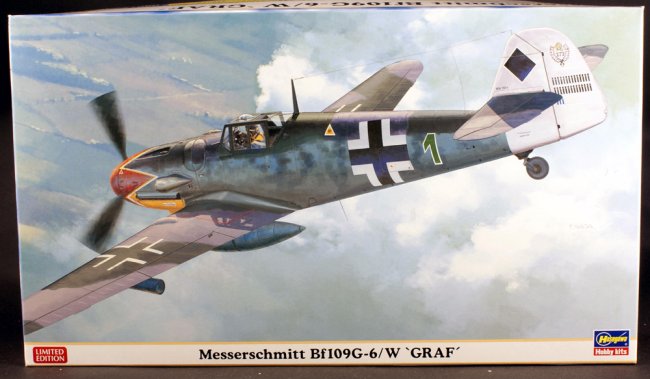
Bf109G-6/W 'Graf' Product #09915 (http://www.hlj.com/product/HSG09915)
Kommodore Major
Hermann Graf served on both the Eastern and Western Fronts during World War 2.
He became the first pilot in aviation history to claim 200 aerial victories. He
claimed a total of 212 aerial victories and flew over 830 combat missions, 202
of which were on the Eastern Front. Graf was born on 24 October 1912 in Engen in
Baden not far from the Swiss border. Graf saw his first aircraft when he was
twelve years old causing an emotional conflict between his passion for football
and aviation. Graf had started working at the Engen town Hall in 1930, saving
all his money to buy a glider. Before his twentieth birthday he contributed a
homemade sailplane to the newly founded Engen Sailplane Club. Every Sunday he
would go out to the nearby Ballenberg mountain until an almost fatal crash
destroyed his sailplane in the fall of 1932. In 1935 when Adolf Hitler nullified
the Treaty of Versailles, Hermann Graf applied for flight training in the newly
created Luftwaffe. Accepted to basic aviation training in 1936, and in
1938 Graf completed the advanced flying training. He was originally selected for
multi-engine aircraft training, but he wanted to fly fighters and was assigned
to Jagdgeschwader 51 (JG 51) 31 May 1939 with the rank of Unteroffizier. On 4
August 1941 Graf got his first aerial victory against an I-16 while escorting a
Ju87 Stuka strike against Kiev. After recovering he was appointed Kommodore of
his old unit JG 52 on 1 October, which was still operating on the Eastern Front.
With German forces in retreat by this time Graf did not have opportunity for air
combat. He managed to bring his tally to 212 before he surrendered to the
Americans on 8 May 1945. Graf was handed over to the Russians shortly after his
surrender and he was imprisoned until 29 December 1949.In 1965 Graf was
diagnosed with Parkinson Disease which had a slow deteriorating effect on his
health. Parkinson's disease affected many of those who had flown high-altitude
missions during the war. Hermann died in his hometown Engen on 4 November 1988.
Click on
images below to see larger images
Hasegawa's 1/48 Messerschimitt
Bf109 series has been around for many years now and most modelers should know
what to expect in the way of plastic from each boxing. The 109 series has to be
one of the most re-issue kits from Hasegawa. I always do enjoying seeing the
different offerings of schemes that are offered in each Limited Release. Total
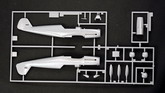
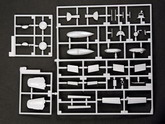
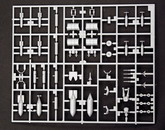
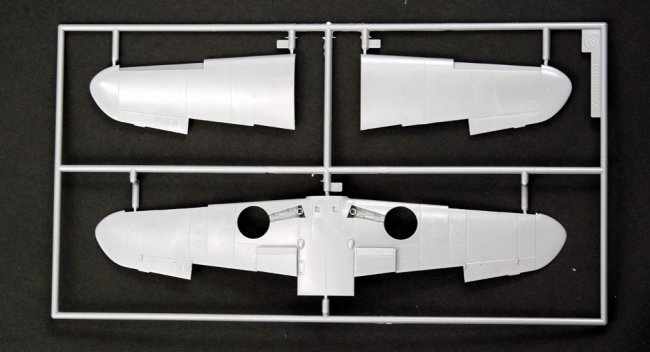
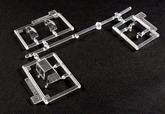
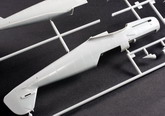
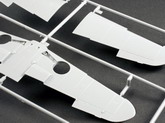
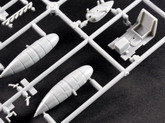
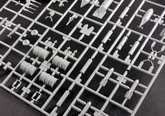
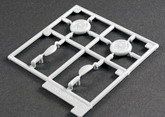
of 91 parts are molded in medium gray and clear plastic. The cockpit is very
basic but will satisfy most builders. However, there are a lot of aftermarket
sets available on the market for Hasegawa's 109s and offer an higher level of
detail. The only hard decision you will have in that area is to choose between
Resin or Photo Etch or you could go right out crazy and choose both! Exterior
detail has fine crisp engraved panel lines. There are some components that
require some sort of modification during the build process, either it be filling
a couple of access locations, engraving panel lines or cutting a bit of excess.
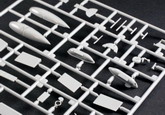
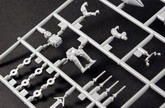
Also included in the kit is two sprues from Luftwaffe set. There are a lot of
parts that are not required for this boxing, there will be a few additions of
ordnance to the spares pile.
The instructions are the typical ones that you get with any Hasegawa kit,
printed in Black and White paper that folds out. The instruction guide is easy
to follow during the build process with colour callouts in GSI Aqueous Colour
and Mr Hobby Lacquer ranges. The markings supplied in the kit are for two Bf-109
G-6 airframes that Kommodore Major Graf flew in September 1943. The first
marking scheme is for a Bf-109 G-6/W, W.Nr 15919, that features the red tulip on
the nose of the aircraft and white tail with 74/75/76 finish. The second scheme
is again for W.Nr 15919, this time it’s a Bf-109 G-6/R6. The paint finish the
same as the first but it doesn't have the red tulip on the front of the
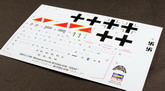
aircraft. The Decal sheet is printed in good colour saturation and excellent
register and minimum carrier film. It appears with the last couple decal sheets
that I have used from some of the recent releases from Hasegawa have been
printed a lot better than some of the older releases. The decals went down with
ease and required very little setting or sol solution. It appears this boxing
has newer printed style of decals, which is great if Hasegawa has changed there
decal manufacturing process. The decal sheet carries all the required markings
and stencils for one airframe.
I am happy to give this kit, two
thumbs up! And would recommend it to any level of experience modeler. With
addition of the numerous of aftermarket items available for this kit, Hasegawa
offers a lovely canvas for a super-detailed build.
I
would like to thank Hobby
Link Japan
for supplying this review sample.Dave
Johnson
|
|