|
Hello, fellow modelers and readers!
Subjects from Sci-Fi movies and TV series have always interested
modelers. These subjects more often than not display a lot of silly features,
when examined in the light of today’s engineering or scientific knowledge. The
subject of this article is just the second Sci-Fi model I’ve built in my life,
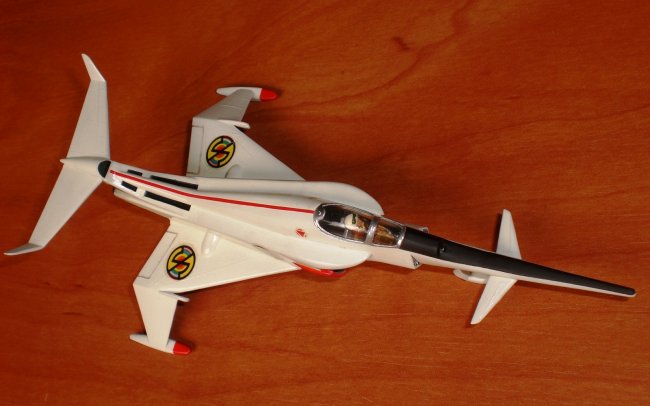
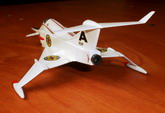
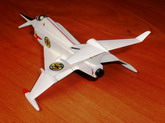
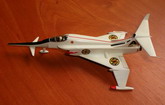
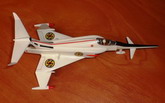
and I think it’s well suited for a silly-week article. It’s the 1/72 scale Airfix Angel Interceptor, from their old Series 2 releases.
How did some people of the 60’s imagine the Fighter of
the Future? The Angel Interceptor, from a Sci-Fi TV series of that era, may be
the answer. According to the kit’s statistics, the Interceptor (a.k.a. “The
Insect” in my family, as the aircraft at certain angles looks like a menacing
insect, and “insect” in spanish –insecto– sounds like a shortened
version of “Interceptor”) was a strike aircraft with a top speed of 3000 mph (roughly 4830 kmh or Mach 3.9,) specially adapted for
Cloudbase
requirements.
Each aircraft weighted just 40,000 lb (roughly 18200
kilos,) cost 1,250,000 sterling pounds, and took 9
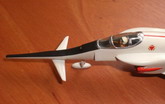
months to build. Its nose probe included sophisticated sensors for air wind and
speed, radar, etc. Its small nose stabilizers prevented nose dipping at high
acceleration regime. Its fuselage housed twin turbo-jet compressors feeding a
rear-mounted ram jet. Bled air was used for maneuvers at both hypersonic and
very low (landing) speeds, and also as braking jets. Armament consisted of a
main cannon which fired a variety of ammunition, and two batteries of
air-to-air (AAM) or air-to-ground (AGM) missiles as well. The aircraft carried mammoth
fuel tanks, despite its compact size.
Was the Interceptor a silly design? I think that the
answer is neither yes nor not. I’ll point out some silly and clever facts of
the aircraft, in the light of today’s combat aircraft features.
Silly facts:
1. The shape of the aircraft seemed not to be suited even for supersonic
speeds, because the fuselage seems not to follow the “rule area.”
2. Such a little aircraft couldn’t carry “mammoth” fuel tanks or a powerful
engine capable of delivering 3000
mph. Real aircraft that flew at Mach 3 (the SR-71 and
the MiG 25) carried very large engines and big
afterburners, and were overall big. Today’s latest generation fighters have
in-flight refueling capacity plus external fuel tanks to increase range.
3. An aircraft flying at 3000
mph cannot fire ammunition because the aircraft is
faster than a bullet!
4. The aircraft operates from Cloudbases… this
concept implies some sort of anti-gravitational forces coming into play, or
that the clouds are at an altitude where no gravity exists, which I think it’s
impossible because it is the gravity force what make the clouds’ particles to
stay more or less together at certain altitude.
5. The needle-shaped nose and the flat and wide fin’s front end would help
to increase the Radar Cross Section (RCS) of the aircraft.
6. The Interceptor was created under the sole premise that “faster is
better.” Today’s combat aircraft are designed with other premises, such as high
survivality, high agility, high payload, multi-role
capacity, ease of maintenance and low RCS (stealth or quasi-stealth
performance.)
7. The Interceptor was painted in a very high visibility painting scheme
and markings, while today’s fighters are painted in low-vis
air superiority camouflage schemes and markings.
Clever facts:
1. The aircraft used front stabilizers (canards) now present in all of the
latest generation of european fighters: the Saab Gripen,
the Dassault Rafale and the Eurofighter Typhoon. Nevertheless, the concept of a
front stabilizer is at least as old as Wright brothers’ first powered airplane,
the Flyer from 1903!
2. The Interceptor anticipated the use of winglets similar to those now
commonly seen on commercial aircraft, and used bled air for control purposes as
in the Buccaneer, the Harrier and other real military aircraft developed before
the Interceptor.
3. The Interceptor’s top speed hasn’t been reached yet by any real aircraft
(except for the rocket-powered North American X-15, which nevertheless had to
be launched from another airplane.) The design and construction of an aircraft
with a performance similar to that of the Interceptor is still an engineering
challenge for the future! However, such a performance isn’t needed for today’s
combat aircraft.
Click on
images below to see larger images
Regarding the kit, it has just 23 pieces and the
typical quality of Airfix kits of the 60’s. I bought
it some 30 years ago and I don’t remember when I began its construction. I
interrupted construction several times and for very long periods, the last for
perhaps three years… The more I thought about the problems I had to solve with
other very old Airfix kits, specially with the
decals, the less I wanted to continue the building of the Interceptor.
By the beginning of 2009 I’d solved more or less
satisfactorily all the assembly problems of the kit, and it only needed to be
painted and decaled, so I decided to finish the kit that year. The white
plastic became cream yellow over the years. It also became fragile, and the
tail stabilizer and the nose cone broke while I was holding the aircraft with
one hand and polishing the plastic with the other. Some of the previously
applied putty also cracked, so I had to make some reparations before priming
the model with white mixed with FS36622 Camouflage Gray (white alone needs many
coats for a satisfactory coverage.)
I know that gloss white turns to cream yellow sooner
or later (many times inside the bottle.) After reading again the article
“Perfect decals” by Paul Boyer in November 2001 FSM, I followed Paul’s
recommendation of painting flat colors first and adding a clear gloss coat
later. I did so with the white of the airframe and also with the red of the air
intake lip and the front of the rear skids, doing so allowed me to match the
red with that of the decals (in fact, the red stripe at the center of the spine
was also painted, because I feared the decal wouldn’t work.) After painting the
red I applied two coats of Tamiya acrylic Clear and
the model was ready for decaling.
I decided not
to use Micro “Liquid Decal Film” this time to prevent the decals becoming
thicker than they already were. I expected any disaster with those more than
30-year old decals, fortunately they behaved better than I expected, so I only
had to cut the clear film in places where it curled a little after the
application of Micro Sol. I then applied three additional coats of gloss clear
to get a very shiny finish.
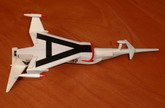
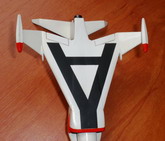
Later I masked and airbrushed the matt black
anti-glare panel and the large “A” letter on the underside, and the metallic
jet exhaust. Then I removed all the masks, painted the guns and retouched the
black plate that goes inside the fuselage at the rear of the air intakes, which
wasn’t completely covered by its mask and received some overspray.
It was December 31, 2009 and I thought the model was
already finished and quickly took some pictures of it. The same day I began to
write this article thinking that I was on time for the January 2010 ARC’s “Silly week.” Then I thought that more information
about the Interceptor would be needed, so I searched the Internet. There I
found more information and photographs on the subject than I anticipated.
According to the information I found, the front
landing skid was retractable (I thought before that it was fixed so it would
perform as a fixed air brake, another silly feature.) I found that Airfix’s kit wasn’t 1/72 scale and also had some mistakes
and simplifications here and there (as anyone may have expected.) I also
noticed that the kit’s painting instructions were incomplete because the canopy
frame should be chrome silver and there is an intake at the top of the fin that
should be painted because it wasn’t molded. Therefore I realized that it was
silly to think that the model was ready at that point and that I could write
the article for 2010’s “Silly week.” Soon the December 2009 vacations ended and
the model was put aside again until March 2010, when I masked and painted the
missing bits. Now I am satisfied with my finished Interceptor (or insecto,) although I had to wait until 2011’s
“Silly week” for the article.
Greetings from Caracas,
a city that regrettably has become the home of two real insects, “white legs” (Aedes
aegypti)
mosquitoes and “chipos,” that transmit tropical
diseases. These little insectos
carry very dangerous weapons, however, they lack an effective IFF system,
therefore identifying every human being as “foe” (or “food”, I’m not quite sure…)
Not a silly matter, of course. The people of my country Venezuela, with
its characteristic sense of humor, when seeing several mosquitoes flying around
a person say, half seriously half joking: “beware of these F-16s, they’re ready
to attack”!
Orlando Sucre Rosales
Click on
images below to see larger images
|