|
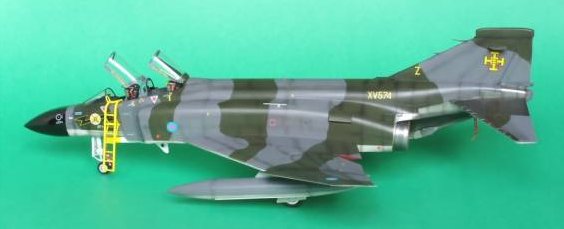
RAF
FGR – 1
Introduction
I
am not going to get into giving a history lesson here on the McDonnell
- Douglas famous F-4 Phantom
II . Anyone with even a slight interest in military aviation I am sure have some
knowledge of this aircraft. However, since I have never seen this aircraft in
real life ( yet ! ) , I have seen it in books and T.V. , and since it can best
be summed up like this ………
“
A machine comes on a practice diversion to our timid training command airfield.
We all tumble to watch it go round the pattern. It cruises through the circuit
in and our, trailing long plumes of smoke from its Smokey engines. The pilot
bends it around the sky in a startling display of reverberating thunder.
Our trainers are also in the air, but they are minute in comparison and
they are silent compared to the muted thunder of this beast. Its great bulk is
full of menace, threatening; indeed the trainers are forced to climb out of the
way because it overhauls them rapidly in the pattern. To me, it looks evil and
brutal , a bull shark entering a pool full of minnows and pilot fish , a
dreadnought battle cruiser surrounded by trawlers . It departs suddenly, in an
appropriately spectacular fashion , accelerating vividly around the finals turn
, blasting past over our heads with its tail on fire and then pulling up to
punch a hole through the clouds , its bulk belying its speed . When its gone ,
the trainers drop back into the pattern , fluttering down to buzz around the
circuit , like clockwork motors in comparison to the war machine that has just
departed . This makes the ultimate impression on me and I resolve…. “
I
know what you are thinking , and
yes , I read this from a book called F-4 Phantom , A Pilots Story by Robert
Prest . I did not have much knowledge of the British Phantoms , so I needed
to gain some vast knowledge of this aircraft as it differed from its American
counterpart. The most noted difference is the engines as the British used the
“ Rolls Royce Spey engines “ as opposed to the American
J – 79’s . Thus the intakes were a little bigger on the British ones
as well.
The
Kit
Manufacture:
Hasegawa
Scale:
1 \ 48
The
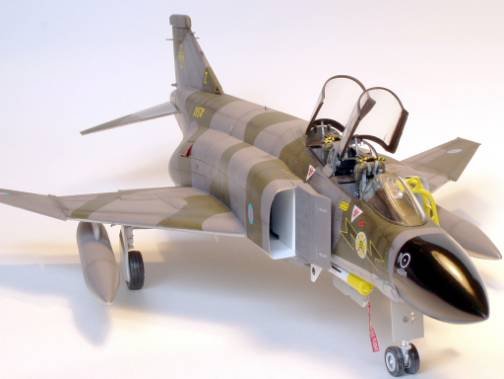
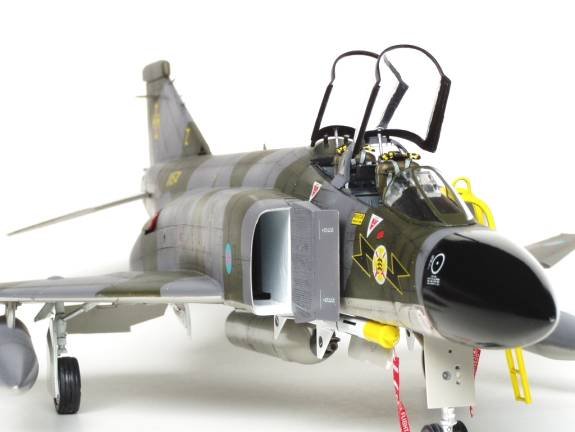
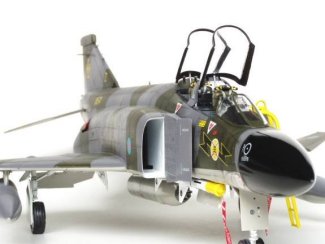
kit was built basically out of the box , with the exception of the scratch built
missile covers. The kit is Hasegawa ‘s typical quality with engraved panel
lines and very few fit problems. The kit comes with rubber tires and metal rims.
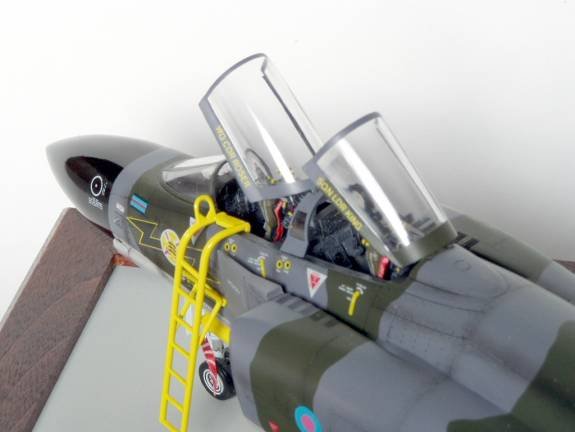
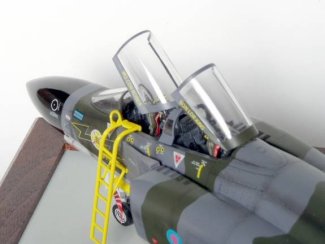
The cockpit has all raised details so a good paint job with the combination of
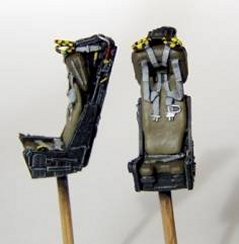
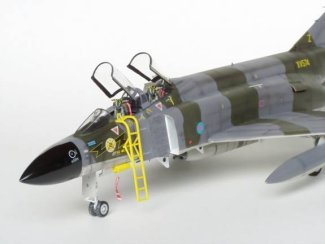
dry brushing is certainly pleasing to the eye. I wasn’t too fond of the seats
supplied with the kit so I used True Details seats for this project, added
RBF tags to the cockpit and a boarding ladder ( thanks to David Augnst ) and
cockpit complete.
Click
on image below to right larger image
|
 |
 |
Painting
I
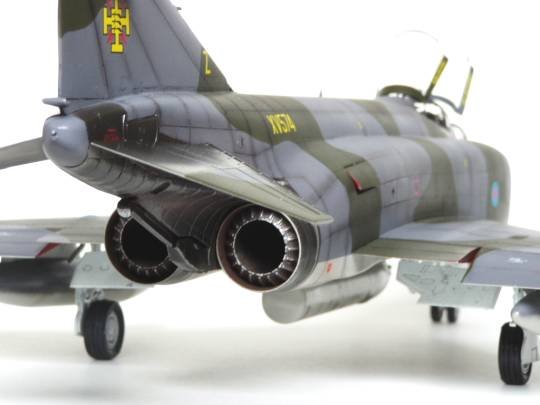
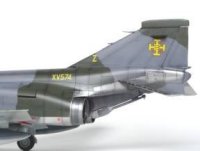
finished the model using Gunzie acrylics. Since the RAF Phantoms were painted
with out a soft edge , I used “fun tac” for masking off the camo scheme ,
this in turn gave me the hard edge I was looking to achieve. The various shades
of metal work on the kit was done using Alclad II and Testors metalizer paints.
Click
on image below to see larger image
|
 |
|
I then futured
the model for panel line work . I used a black wash ( enamel paint
) on all the panel lines on the aircraft. Then used a post shading
technique to further enhance the subtle but weathered look of the dirty
Phantoms. Applied the decals but felt they went on thick
, even with solv- a – set setting solution. I would recommend
aftermarket decals instead of the Hasegawa rather thick decals. I applied
another coat of future to seal the decals and finished it off with a coat
of flat Gunzie. |
Conclusion
This
was a fun kit to build. It took some researching, I obtained a lot of the info
on this aircraft from a friends book collection , and the afore mentioned book
by Robert Prest. I plan on doing another one in the future as I obtained an F-4
Black Box cockpit set. This kit comes highly recommended.
MDK
|
Click on
images below to see larger images
|
|
|
|
|
|